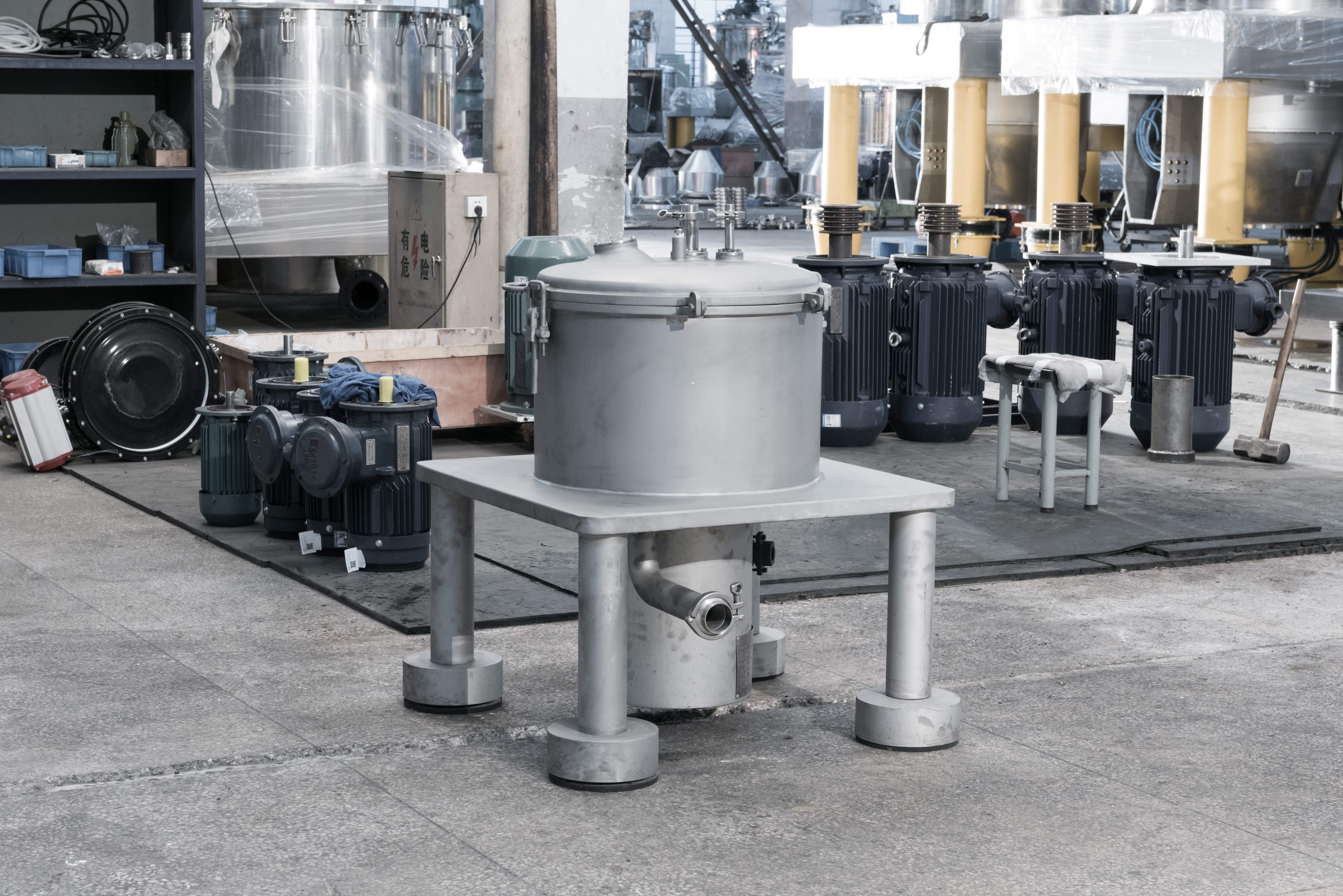
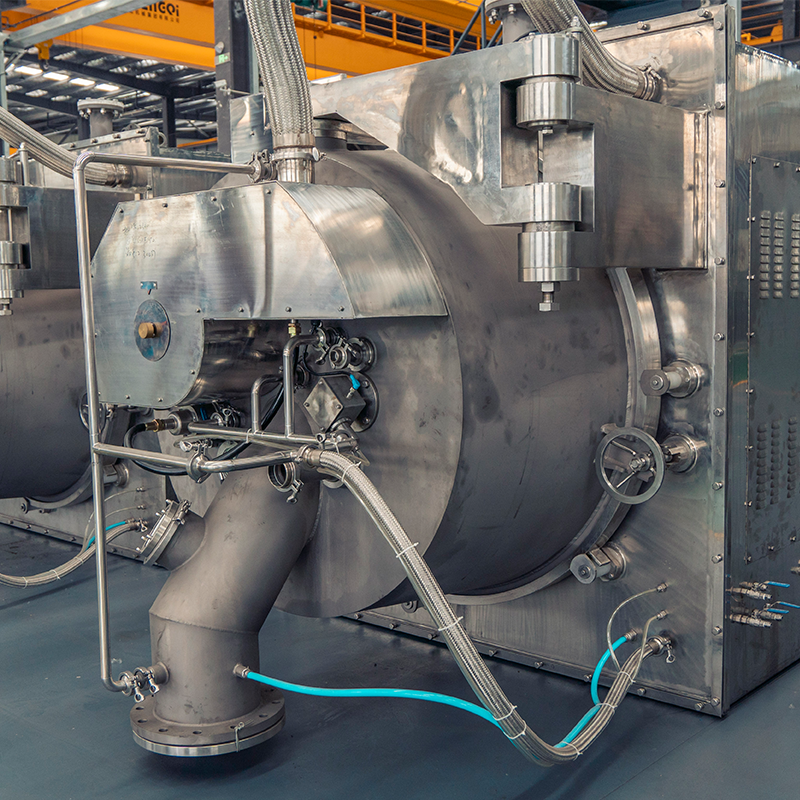
The environmental conversation around industrial machinery usually starts with energy consumption, but the quieter gains often live in mechanical design. A top suspended centrifuge is one of those cases where a structural decision made for process stability ends up delivering a surprisingly broad set of environmental benefits. Fewer lubrication points, lower noise, less auxiliary equipment, and a longer service life all ripple out into a smaller footprint over the machine’s entire operating lifetime.
The fundamental difference sits in the bearing arrangement. Instead of supporting the rotating basket from both above and below, a top suspended centrifuge hangs the entire assembly from a single, robust upper bearing. The lower bearing disappears, and with it goes the need for a continuous lubrication supply to that point. In a traditional bottom-bearing machine, even a well-maintained unit might consume forty to sixty liters of bearing oil per year when factoring in changes, leaks, and top-ups. Eliminate that lower bearing, and that oil consumption simply vanishes from the operation’s environmental ledger.
Tracking lubrication as an environmental metric is not standard practice in most plants, which is precisely why the savings go unnoticed. Used bearing oil enters the waste stream, requires documented disposal, and carries the risk of incidental spills onto the factory floor or into drainage systems. A mid-sized chemical intermediates facility in the Pearl River Delta replaced three older bottom-driven basket centrifuges with top suspended units during a production line upgrade. Within the first twelve months of operation, the site’s hazardous waste manifest for used lubricating oil dropped by roughly 180 liters, a figure that caught the attention of the environmental compliance team because it simplified their annual reporting. No one had anticipated that a centrifuge replacement would move the needle on a regulated waste stream, but the mechanical design made it a direct outcome.
Power draw tells a similar story. A lower bearing under cyclic load is a constant source of frictional drag, especially as the basket accelerates and decelerates through the spin cycle. The top suspended configuration aligns the rotating mass along a single vertical axis, allowing it to self-center naturally. The result is a lower baseline current draw during the high-speed phase. The difference per cycle might look trivial on a bench meter, but multiplied by six thousand to eight thousand operating hours per year, it compounds.
A typical 48-inch top suspended centrifuge processing dye intermediates might pull around 36 to 38 kilowatts under full load. An equivalent bottom-driven machine with dual bearings can easily require 41 to 43 kilowatts for the same basket size and slurry. That delta of five kilowatts, sustained over an eight-thousand-hour year, represents forty thousand kilowatt-hours. In regions where grid power still depends heavily on coal, that is a direct carbon reduction worth reporting in a corporate sustainability disclosure.
Environmental impact is not only about carbon and waste. Noise exposure on the factory floor and in the surrounding community counts, too. Centrifuges, particularly large ones, generate significant sound pressure levels. Much of the high-frequency whine in a conventional machine originates from the lower bearing assembly as it absorbs the ever-shifting imbalance of the load. Removing that bearing changes the acoustic signature noticeably. Measurements taken during commissioning at a European starch processing facility showed that top suspended centrifuges consistently registered six to eight decibels lower at the operator station compared to the previous generation of bottom-driven units. A drop of six dBA reduces the perceived loudness by roughly half, which means standard hearing protection becomes adequate, and the ambient noise bleeding into adjacent neighborhoods diminishes.
Because a top suspended centrifuge self-stabilizes, the basket achieves a more uniform cake distribution. Uniform cake distribution means wash solvents flow through the solids bed evenly, without channeling or bypass. The practical outcome is that target impurity removal is achievable with less solvent volume per batch. In pharmaceutical intermediate production, where acetone or ethanol serves as the wash medium, a ten to fifteen percent reduction in solvent usage per batch cascades directly into lower steam demand in the downstream distillation column that recovers the solvent for reuse. The centrifuge does not become more efficient because of an add-on technology; it becomes more efficient because its core mechanical stability makes the wash step inherently more effective.
Sustainability assessments increasingly look beyond operational energy to include the embodied carbon of the equipment itself. A machine that operates for eighteen years instead of twelve halves the amortized carbon cost of its own manufacture per ton of product processed. The top suspended design contributes to that longevity by reducing uneven loading on the basket wall and drive components. Fatigue-related cracking, a common retirement trigger for high-speed rotating equipment, occurs less frequently when the mass is free to find its own rotational center. Maintenance logs from several operating sites suggest that major overhauls on top suspended centrifuges tend to occur at longer intervals compared to their bottom-bearing equivalents, though the exact benefit varies with process severity.
| Environmental Parameter | Bottom-Driven Centrifuge | Top Suspended Centrifuge |
|---|---|---|
| Bearing oil consumption | 40–60 L/year | Negligible |
| Typical power draw (48-in basket) | 41–43 kW | 36–38 kW |
| Wash solvent volume vs. baseline | Baseline | 10–15% lower |
| Operator station noise level | 88–92 dBA | 82–86 dBA |
| Typical interval between major overhauls | 5–7 years | 7–10 years |
Processors facing tighter environmental reporting requirements are beginning to examine the mechanical design of their capital equipment as a variable in their sustainability metrics. A machine that inherently consumes less oil, draws less current, and asks for less solvent over its life simplifies the data-gathering effort behind Scope 3 and operational emissions reports. Manufacturers that build this thinking into their equipment from the structural level outward give their customers a head start. HuaDa centrifuge produces top suspended models engineered with an understanding of these lifecycle demands, combining the intrinsic mechanical benefits of the suspended design with reliable, well-documented performance that supports credible sustainability claims. For a plant manager looking at next year’s environmental targets, that kind of built-in efficiency makes the centrifuge specification more than a process choice.
 Hot News
Copyright © 2025 Jiangsu Huada Centrifuge Co., Ltd. All Rights Reserved Privacy policy
No. 88 Qigan Road, Yangshe Town, Zhangjiagang City, Jiangsu Province, China
Copyright © 2025 Jiangsu Huada Centrifuge Co., Ltd. All Rights Reserved Privacy policy
 EN
EN
 AR
AR
 HR
HR
 CS
CS
 DA
DA
 NL
NL
 FI
FI
 FR
FR
 DE
DE
 EL
EL
 HI
HI
 JA
JA
 KO
KO
 NO
NO
 PL
PL
 PT
PT
 RO
RO
 RU
RU
 ES
ES
 SV
SV
 TL
TL
 ID
ID
 LT
LT
 SR
SR
 SK
SK
 UK
UK
 VI
VI
 HU
HU
 TH
TH
 TR
TR
 FA
FA
 MS
MS
 IS
IS
 LO
LO
 LA
LA
 MN
MN
 MY
MY
 KK
KK
 UZ
UZ
 IT
IT