
It might surprise some to learn that we've all encountered the work of a centrifuge during the process of taking a pill, getting vaccinated, or receiving a doctor-prescribed cream - and that a centrifuge was actually a crucial part of the process. Centrifuges are the unsung heroes of the pharmaceutical industry. Centrifuges assist in an extremely valuable process - solid-liquid separation - regarding the treatment of solid and liquid mixtures. Broadly speaking, pharmaceuticals can be derived from a variety of mixtures including, but not limited to, biological cell cultures, or suspensions containing valuable crystallized compounds. In pharmaceuticals, there are mixtures that need to be separated from one another in order to create drugs that are safe and effective for public use. To achieve this, high efficiency centrifuges are utilized.
For decades, companies like Huada have pushed the boundaries of engineering and construction of these types of machines. Having 30 years experience with hundreds of patents, they know the specific and unique requirements of the various fields, especially pharmaceuticals. It's not simply about spinning fast, but about doing so with extreme accuracy and reliability, while also adhering to the world's highest standards of cleanliness and safety. So, why exactly is a high efficiency centrifuge so critical to the production of life saving drugs?
Pharmaceutical production is highly regulated and standardised, and for good reason. To ensure purity and the regulated production of drugs that saves lives, the medicine cannot be created in a manner similar to how a cake is mixed. It is essential that no particles from the production of previous drugs are left in any of the production equipment, otherwise it will result in potential contamination. Waste is also unacceptable in the production of hard to synthesise drugs, so an efficient separation process is paramount.
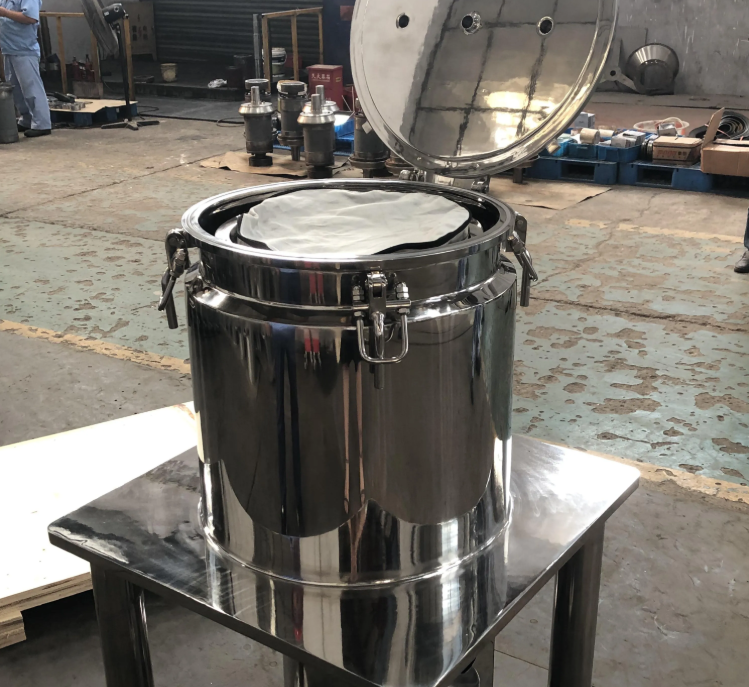
Where centrifuges used in pharmaceuticals differ from those used in, for example, mining or wastewater treatment, is in the construction materials used. For example, the centrifuges used in pharmaceuticals are made from high-grade stainless steel, which is non-reactive and easy to clean, and allow for ''in place'' clean and sterilization procedures. This means that the centrifuges can be cleaned and sanitized thoroughly without being disassembled. This ensures that there is no contamination between batches of pharmaceuticals, which is an absolute requirement of the drug manufacturing process. This expectation is the foundation for the design of high-efficiency centrifuges specifically tailored to pharmaceuticals.
Valuable products are often the most difficult to isolate. This is one of the most difficult aspects of pharmaceutical production. For example, suppose you are culturing a specific strain of bacteria that is capable of synthesizing a novel compound that has significant therapeutic value. After days of meticulous work, you would have a culture that is worth a significant amount of money, but most of the volume of the culture would be comprised of liquid, and you would need to extract every milliliter of the valuable compound.
High efficiency centrifuges are able to do this. They are able to create massive amounts of centrifugal force (multiple thousands of times the force of gravity), allowing them to separate even the minutest particles from the liquid. In turn, this results in less waste, which in turn, results in higher yields. For pharmaceutical companies, the higher the yield and the lower the waste, the lower the cost of producing the drug, and the more accessible the drug is to the patient. A big difference, both economically and from a waste perspective, is a machine that recovers 99% of a product instead of 95%.
You have likely heard of Good Manufacturing Practice, or GMP. These are the stringent guidelines that pharmaceutical companies have to comply with in order to keep their products safe and their practices safe. These guidelines apply to the centrifuge also. This means the centrifuge must have smooth surfaces with no difficult to clean crevices, and must have sealing mechanisms to prevent any leakage.
A commitment to cleaning comes first when designing high-efficiency centrifuges specific to the industry. The steel polishing, gasket choice, and welded joints made to eliminate cleaning and inspection obstacles all work towards this goal. And this is not merely box-ticking work. Next, when the patient receives their meds, they receive what is prescribed and absolutely nothing else. Companies like Huada, with decades of experience, have spent years honing and refining this design.
The fascinating world of the pharmaceutical industry begins its journey with the research lab. Here, scientists will utilize a small benchtop centrifuge to separate a few milliliters of a newly developed compound to analyze the sample. If the sample analysis yields a positive result, the next step is scale up. First, they will move on to the pilot plant to produce small batches, and finally, they will be able to achieve full-scale commercial production, which will allow them to process thousands of liters every day.
This is when the importance of different types of centrifuge models is really highlighted. A reputable manufacturer should provide different sizes and types of machines that can accommodate these different phases. Whether it is a vertical peeler centrifuge for a specific batch process or a decanter centrifuge for continuous flow operations, the technology should be vertically integrated. The principles of high-efficiency centrifuges that work in a laboratory setting should be demonstrated in the large-scale versions in the production hall. The ability to scale up reliably is the key to getting new drugs developed in the laboratory to the pharmacy shelf.
In the production of pharmaceuticals, safety is a two-way process. You have to safeguard the product against contamination and also have to ensure the safety of the personnel handling the product. Some active pharmaceutical ingredients can be very active or even toxic. The work environment may become dangerous if a powder or liquid pharmaceutical contaminates the air.
Modern high-efficiency centrifuges have fully enclosed designs for these reasons. Separation is done within one sealed drum. The loading of product, spinning, washing, and discharging occur without any contact to the external environment. This design protects the operators of the machine. It also protects the product from any airborne dust or dirt from the factory. This design is a perfect example of design that enhances safety and reliability of the entire manufacturing process.
The innovation driven experience continues to refine machine technology. The best example is Huada, one of the best R&D companies, has hundreds of active patents. Huada continues to refine technology for more energy efficient drives, highly sophisticated control systems that can monitor the entire process and materials that have longer useful life and cleaner surfaces to promote efficient processing.
Real needs of the pharmaceutical industry inspire this innovation. Separation challenges become even harder as drugs grow in complexity, with things like targeted therapies and biologics. This industry demands more precise, gentler, and more efficient centrifuges. The knowledge gained from thousands of installations around the globe feeds into the construction of the next generation centrifuges.
In a way, an ultra perfomance centrifuge is much more than a spinning drum. It is a precision tool, a protector of purity, and an important component of the life-saving drug development chain. From the beginning of the development process to the end, these machines work hard to support the healthcare industry while staying silent. The next time you take a dose of medicine, you might as well think about the powerful centrifuge that made it pure and safe.
 Hot News
Copyright © 2025 Jiangsu Huada Centrifuge Co., Ltd. All Rights Reserved Privacy policy
No. 88 Qigan Road, Yangshe Town, Zhangjiagang City, Jiangsu Province, China
Copyright © 2025 Jiangsu Huada Centrifuge Co., Ltd. All Rights Reserved Privacy policy
 EN
EN
 AR
AR
 HR
HR
 CS
CS
 DA
DA
 NL
NL
 FI
FI
 FR
FR
 DE
DE
 EL
EL
 HI
HI
 JA
JA
 KO
KO
 NO
NO
 PL
PL
 PT
PT
 RO
RO
 RU
RU
 ES
ES
 SV
SV
 TL
TL
 ID
ID
 LT
LT
 SR
SR
 SK
SK
 UK
UK
 VI
VI
 HU
HU
 TH
TH
 TR
TR
 FA
FA
 MS
MS
 IS
IS
 LO
LO
 LA
LA
 MN
MN
 MY
MY
 KK
KK
 UZ
UZ
 IT
IT


